
Website Versus Sales Funnel: Which One Do You Need?
If you are building an online business, you have probably heard people talk about websites and sales funnels as if you must choose one over the other.
Some will say, “You need a website.”
Others will say, “Websites are outdated. You need a funnel.”
The truth is simple: a website and a sales funnel serve different purposes. One helps people explore your brand. The other guides them toward a specific action.
The question is not which one is better.
The better question is: What are you trying to accomplish right now?
If you understand the difference, you can build with more clarity, avoid wasted effort, and create a digital system that actually supports your goals.
What Is a Website?
A website is your digital home.
It is the place people visit to learn who you are, what you offer, what you believe, and how they can connect with you. A good website gives visitors a broad view of your business, ministry, coaching practice, services, products, and brand story.
Your website may include pages such as:
Home
About
Services
Blog
Contact
Testimonials
Resources
Courses
Community
Shop
A website is helpful because it allows people to browse, explore, and understand your credibility. It gives your work a stable online presence.
For coaches, creators, consultants, ministry leaders, and entrepreneurs, your website answers key questions:
Who are you?
Who do you serve?
What do you offer?
Why should people trust you?
How can they take the next step?
A website is especially useful when someone is researching you, checking your credibility, reading your content, or learning more before making a decision.
What Is a Sales Funnel?
A sales funnel is a focused path designed to guide someone toward one specific outcome.
Unlike a website, a funnel removes distractions. Instead of giving people many pages to explore, it leads them step by step toward a clear action.
That action may be:
Downloading a free guide
Joining an email list
Registering for a webinar
Booking a call
Purchasing a digital product
Enrolling in a course
Joining a membership
Applying for coaching
A simple funnel might look like this:
A visitor lands on a page.
They enter their name and email to receive a free resource.
They are taken to a thank-you page.
They receive follow-up emails.
They are invited to book a call or purchase an offer.
A funnel is not just a page. It is a guided journey.
The purpose of a funnel is conversion. It helps move someone from interest to action with less confusion.
The Main Difference Between a Website and a Sales Funnel
A website is built for exploration.
A funnel is built for action.
A website says, “Look around and learn more.”
A funnel says, “Take this next step.”
That difference matters.
When someone lands on your website, they may click your blog, read your about page, browse your services, check your contact page, and leave without taking action. That is not always bad. Websites help build trust over time.
But when someone lands on a funnel, the path is more intentional. The page usually has one message, one offer, and one call to action.
Both are useful. They simply serve different moments in the customer journey.
When You Need a Website
You need a website when you want to establish a credible online presence.
A website is ideal when people need to understand the full picture of who you are and what you do. It helps you build trust, share content, and provide a central home for your brand.
You may need a website if:
You offer multiple services or programs.
You want to publish blog posts for SEO.
You need an about page that shares your story.
You want a professional place to send people.
You want visitors to explore your work before taking action.
You serve different audiences.
You want to build long-term brand authority.
A website works well for credibility, visibility, and relationship building.
If you are a coach, speaker, author, consultant, creator, or ministry leader, your website gives people a place to understand your message and trust your voice.
When You Need a Sales Funnel
You need a sales funnel when you want people to take one specific action.
A funnel is ideal when you have a focused campaign, offer, resource, or promotion. It helps reduce distractions and guide people toward a clear decision.
You may need a funnel if:
You want to grow your email list.
You are offering a lead magnet.
You are promoting a webinar.
You want people to book discovery calls.
You are launching a course.
You are selling a digital product.
You are inviting people into a coaching program.
You want to test a specific offer.
You are running ads.
A funnel works well when you want measurable action.
Instead of sending people to a general homepage and hoping they find the right link, a funnel gives them one focused pathway.
Which One Should You Build First?
The answer depends on your current goal.
If you are just getting started and need credibility, build a simple website first. It does not need to be complicated. A homepage, about page, services page, and contact page may be enough to get started.
If you already have an offer and want leads or sales, build a funnel first. A simple landing page with a strong call to action may produce results faster than a full website.
If you are launching a lead magnet, course, coaching offer, or digital product, a funnel may be the more urgent priority.
If you are building your brand for long-term visibility, your website matters.
The strongest online businesses eventually use both.
Your website builds trust.
Your funnel creates movement.
Why Many Business Owners Get Stuck
Many entrepreneurs spend months trying to build the perfect website before they have a clear offer.
Others build funnels before they have clarified their audience, message, or transformation.
Both mistakes create frustration.
A beautiful website cannot fix an unclear message.
A funnel cannot convert well if the offer is confusing.
Before you build either one, clarify:
Who do you serve?
What problem do you solve?
What outcome do you help people achieve?
What is the next step you want them to take?
What tool or page will best support that step?
Clarity comes before complexity.
The Role of a Lead Magnet Funnel
One of the best starting points for coaches, creators, and service providers is a lead magnet funnel.
A lead magnet is a free resource people receive in exchange for their name and email address. It may be a guide, checklist, workbook, training, devotional, template, or mini-course.
A lead magnet funnel helps you build your email list and begin a relationship with potential clients or customers.
Here is how it works:
You create a helpful free resource.
You build a landing page for that resource.
A visitor signs up with their name and email.
The system delivers the resource automatically.
You follow up with emails that serve, teach, and invite.
This is powerful because most people are not ready to buy when they first discover you. A funnel helps you stay connected and build trust over time.
The Role of a Sales Page Funnel
A sales page funnel is built to sell a specific offer.
This could be a course, coaching program, membership, ebook, workshop, or digital product.
A strong sales page does more than list features. It speaks to the problem, explains the transformation, builds trust, answers objections, and invites the reader to take action.
A sales funnel may include:
A sales page
A checkout page
A thank-you page
A confirmation email
A follow-up sequence
An upsell or next-step offer
This kind of funnel helps people move from interest to decision.
It also helps you track what is working. You can measure page visits, sign-ups, purchases, email engagement, and conversion rates.
The Role of Your Website Blog
Your blog is one of the strongest reasons to maintain a website.
Blog posts help you answer questions your audience is already searching for. They allow you to teach, build trust, share your perspective, and increase your visibility through search engines.
For example, a coach might publish posts like:
How to Start an Online Coaching Business
How to Build Confidence as a New Coach
What to Include in a Coaching Package
Website Versus Sales Funnel: Which One Do You Need?
Each post can lead readers toward a relevant next step, such as downloading a resource, booking a call, joining a newsletter, or exploring a platform.
Your blog helps people find you.
Your funnel helps people take action after they find you.
Why Your Website and Funnel Should Work Together
The best digital systems do not treat websites and funnels as enemies.
They connect them.
Your website can send visitors to your lead magnet funnel.
Your blog posts can invite readers to download a guide.
Your about page can lead to a booking funnel.
Your services page can lead to an application funnel.
Your email sequence can send people back to helpful blog posts.
Your funnel thank-you page can invite visitors to explore your website.
When everything works together, your online presence becomes more intentional.
Instead of random pages and disconnected links, you build a journey.
That journey helps people discover you, trust you, learn from you, and take the next step.
Common Mistakes to Avoid
One common mistake is putting too many options on a funnel page. A funnel should be focused. If the goal is to download a free guide, do not distract people with ten different links.
Another mistake is having a website with no clear call to action. A visitor should never have to wonder what to do next.
Some people also build pages before clarifying their offer. The design may look good, but the message does not move people.
Others rely only on social media and never build an owned platform. Social media is helpful, but your website, email list, and funnels give you more control over your audience relationship.
Finally, many people use too many disconnected tools. When your website, funnels, emails, products, and automations do not work together, your business becomes harder to manage than it needs to be.
What Should Your Call to Action Be?
Every website page and funnel page should have a clear call to action.
But not every call to action should be the same.
A homepage might invite visitors to explore your services.
A blog post might invite readers to download a free resource.
A lead magnet page should invite them to opt in.
A sales page should invite them to buy or enroll.
A coaching page might invite them to book a call.
A contact page should invite them to send a message.
The call to action should match the visitor’s level of readiness.
Do not ask someone to make a high-commitment decision before trust has been built. Guide them one step at a time.
Website or Funnel? A Simple Decision Guide
Choose a website when your goal is credibility, SEO, content, brand presence, and helping people explore your work.
Choose a funnel when your goal is leads, sales, registrations, bookings, applications, or focused conversions.
Choose both when you are ready to build a complete online system.
A website is your home.
A funnel is your guided pathway.
Your email list is the relationship bridge.
Your offer is the transformation you provide.
Your system should make all of those pieces work together.
Build With Less Tech Overwhelm
You do not need more digital confusion. You need a simple system that helps you build, connect, and grow.
For many coaches, creators, ministry leaders, and entrepreneurs, the challenge is not a lack of passion. It is having too many disconnected tools and not enough structure.
That is why an all-in-one online business platform can be so helpful.
When your website, landing pages, funnels, email campaigns, digital products, online courses, payments, and automations live in one place, you can build with more clarity and less overwhelm.
You can stop fighting the tools and start focusing on the people you are called to serve.
Ready to Build Your Website and Funnels in One Place?
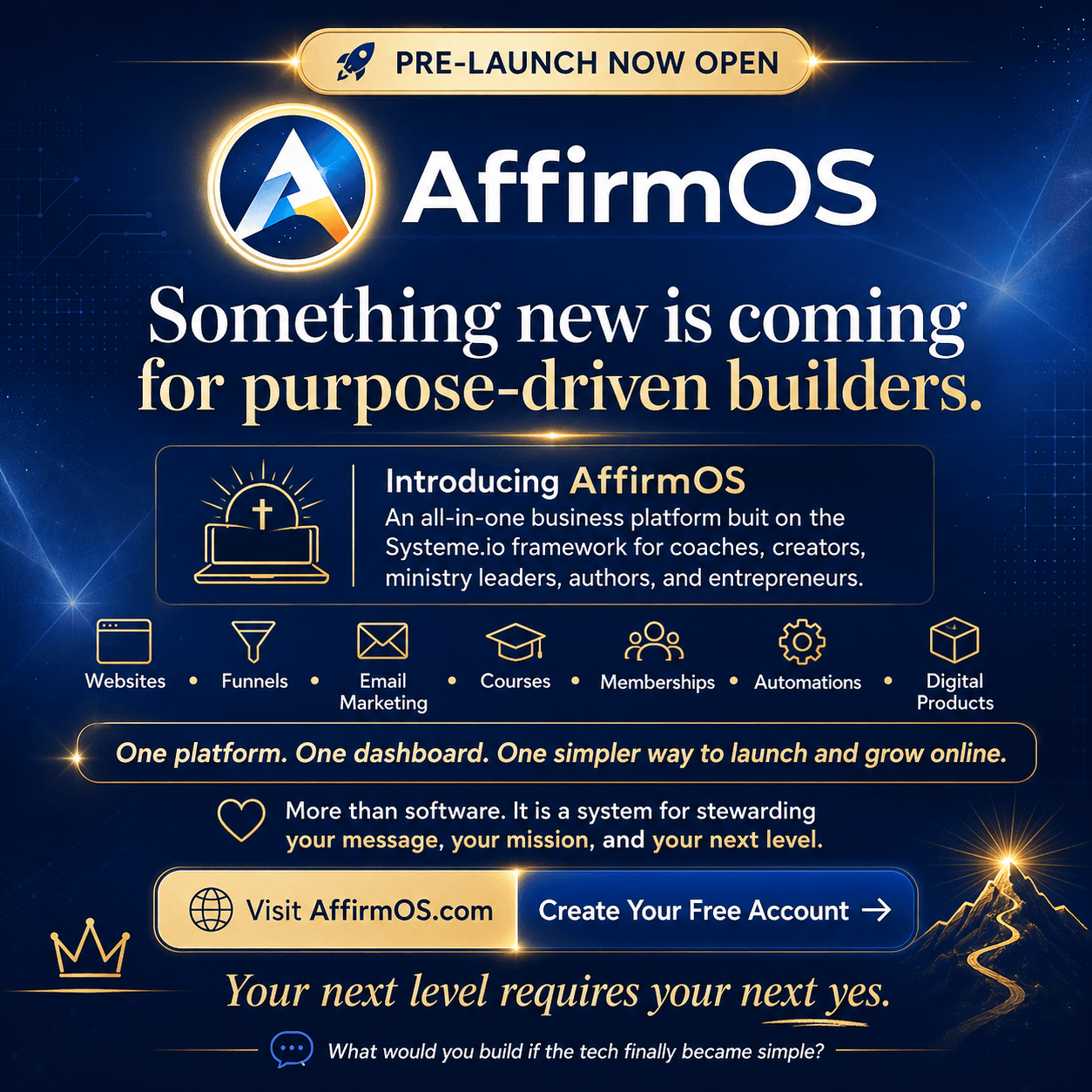
If you are ready to create a clear online presence, build focused funnels, grow your email list, and launch your offers with less tech overwhelm, visit AffirmOS.com.
AffirmOS is designed to help purpose-driven coaches, creators, ministry leaders, and entrepreneurs build websites, funnels, email campaigns, digital products, online courses, and automations from one simple platform.
Check out the primary site today: https://www.affirmos.com


Created with ©systeme.io